Maria Cuenca-Cambronero
Exciting news!
PhD position from January 2027 on the WaterLand project, supported by four years of funding. Applications are now open here!
From May 2027, I will also be recruiting a Postdoctoral researcher . The project will examine biodiversity–ecosystem functioning relationships, with a particular focus on pond ecosystems and on interactions between terrestrial and aquatic environments.
State of the art
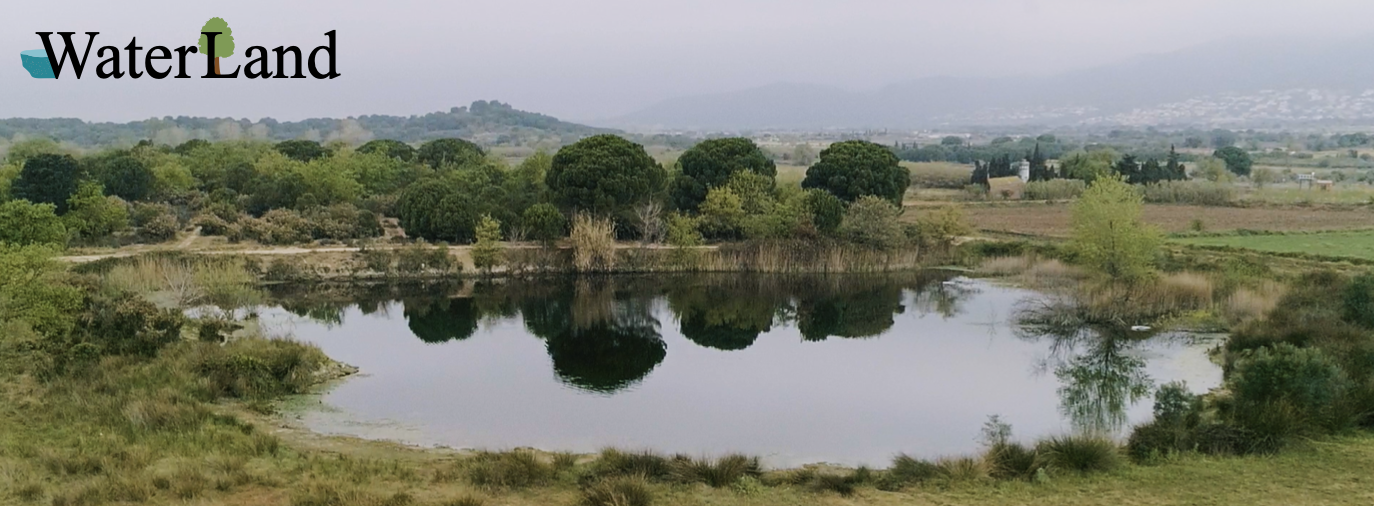
The concept of biodiversity-ecosystem functions (BEF) proposes that increasing biodiversity enhances the capacity of ecosystems to sustain multiple functions and services. While this framework has received significant attention in recent decades, most research has focused on analyses within a single ecosystem, overlooking joint effects across adjacent ecosystems, such as ecotones between terrestrial and freshwater realms, where energy, matter, and organisms are constantly exchanged. Given current biodiversity loss and ecosystem simplification driven by Global Change, conducting BEF research across ecosystems is imperative. In the WaterLand project, I will assess BEF relationships across aquatic (i.e., ponds) and terrestrial ecosystems within the Mediterranean landscape.
Mediterranean regions are a global biodiversity hotspot, but also one of the most vulnerable areas worldwide, with freshwater-terrestrial ecotones remaining critically understudied, despite their considerable potential for buffering extreme climatic events. Ponds, meanwhile, are among the most abundant and diverse freshwater habitats, providing critical ecosystem functions and services (e.g., carbon storage, flood control and pollination). Still, they are increasingly vulnerable and remain underrepresented in BEF studies, particularly in cross-ecosystem contexts. This knowledge gap limits our understanding of how aquatic-terrestrial interactions are critical to maintaining ecosystem functions and providing essential services to society, including climate change mitigation.
Within this framework, I will investigate how taxonomic and functional diversity of terrestrial plants modulate pond biodiversity and ecosystem processes, and evaluate the factors, such as landscape structure and climate, that govern BEF relationships across ponds and terrestrial habitats. Ultimately, WaterLand aims to generate valuable insights to identify key aspects for conserving ponds and their sustainable terrestrial habitats, offering strategies for creating and restoring Mediterranean ponds.
Objectives
The overarching aim of my research line is to determine the relationships between biodiversity and ecosystem functions across terrestrial-aquatic ecotones in the Mediterranean basin.
Objective 1: Assessing the influence of terrestrial complexity on pond biodiversity and functioning.
- How do Functional Diversity (FD), Taxonomic Diversity (TD) and structural heterogeneity of terrestrial plants influence ponds’ BEF interactions on pond ecosystems?
- Does the FD of terrestrial plants, measured at individual traits and CWM, provide better support than TD for the pond BEF interaction?
Objective 2: Assessing the influence of bioclimatic gradient and local environmental factors on BEF relationships.
- How do local factors, such as light penetration, nutrient availability, and hydrological regimes, affect the BEF relationship between terrestrial and pond ecosystems?
- How do bioclimate factors, such as temperature and aridification, alter biodiversity and ecosystem function in both ponds and terrestrial ecosystems?
Objective 3: Experimental microcosms.
- Do high-quality OM inputs enhance microbial diversity and boost ecosystem functioning in aquatic ecosystems?
- Do low-quality OM inputs impair soil microbial communities and reduce pond ecosystem performance?
Methodology
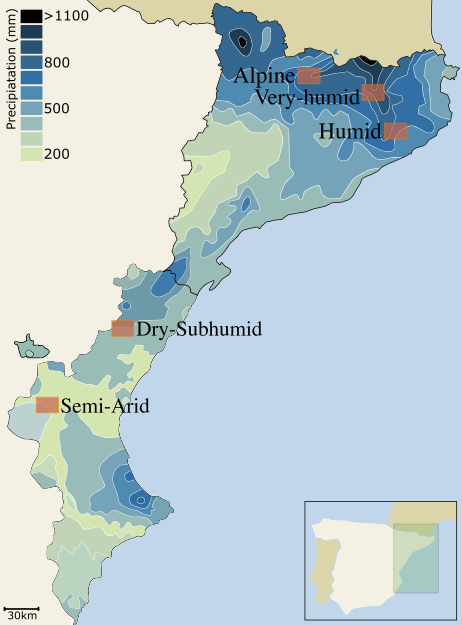 To achieve the WaterLand objective, we will sample a total of 50 ponds and their surrounding terrestrial ecosystems across five zones (10 ponds per area) from the eastern part of Valencia to the north of Catalonia (Fig. 2). These locations were specifically chosen to cover a bioclimatic gradient based on annual precipitation records spanning over 30 years. The five areas include: semi-arid (200 - 300 mm/year), dry-subhumid (300 - 600 mm/year), humid (600 - 1000 mm/year), very humid (>1000 mm/year), and alpine sites (>1000 mm/year). We also incorporate two levels of terrestrial complexity (high and low) based on Taxonomic and functional diversity and structural heterogeneity, which will be determined within 10 meters from the pond edge. Each site will be sampled twice per year (spring and autumn) to capture pond seasonality and vegetation dynamics. Climatic variables, including Aridity Index (AI; mean annual precipitation/potential evapotranspiration) and mean annual temperature (MAT), will be extracted from the WorldClim database. From each site, a standardised stratified survey will be conducted to collect a comprehensive dataset on environmental factors, taxonomic and functional diversity, and the ecosystem from terrestrial and aquatic ecosystems.
Turning plans into action
For the development of this project, I plan to apply to several funding bodies, including the ERC Starting Grant from Horizon Europe, which offers opportunities for funding innovative projects to researchers with outstanding academic record.